
Desperate Situation Revealed in Latest "State of Scams in..." Reports by GASA, ScamAdviser, and Whoscall

The Global Anti-Scam Alliance (GASA) has released three annual "State of Scams" reports: The State of Scams in Malaysia 2024 , The State of Scams in Thailand 2024 , and The State of Scams in Taiwan 2024 . These reports, created in collaboration with Whoscall and ScamAdviser , shed light on the impact of scams in East and Southeast Asia. While the threat of scams is omnipresent across all three nations, the trends, methods, and impacts vary significantly. By analyzing the findings from each country, we can better understand both regional commonalities and the unique challenges faced by each population in the fight against fraud.
Scam Encounters See Common Trends but Different Frequencies
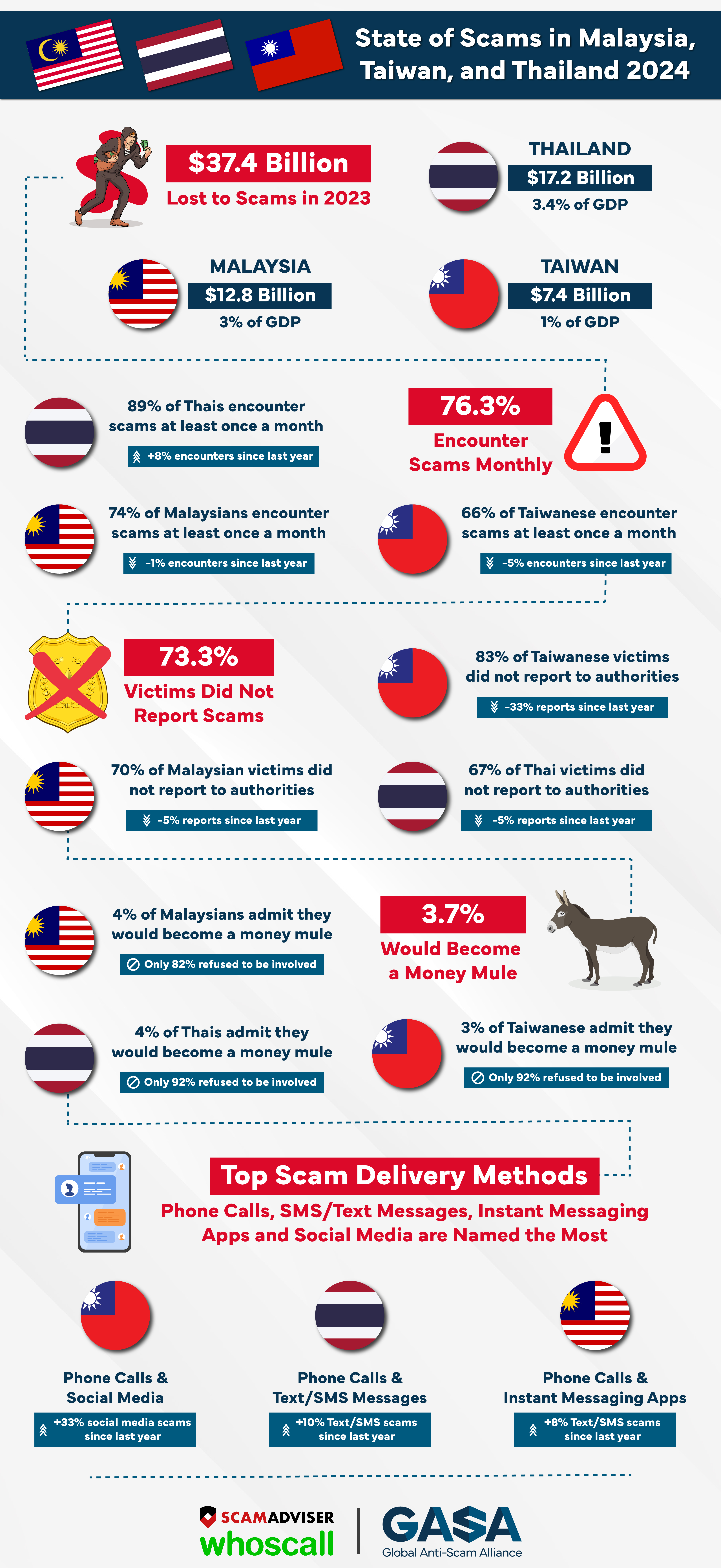
A key takeaway from all three reports is that scam encounters are alarmingly frequent across Malaysia, Thailand, and Taiwan, with scammers targeting between 66% and 89% of the population at least once per month. However, the frequency of scam encounters varies significantly between these countries.
In Thailand , 89% of respondents reported encountering scams monthly, a 10% increase from the previous year, making Thailand the most targeted population among the three countries.
Malaysia also sees widespread scam activity, with 74% of Malaysians encountering scams on a monthly basis. While this is slightly lower than in Thailand, the 43% of Malaysians reporting an increase in scam activity over the past year indicates that the threat remains severe.
In Taiwan , 66% of respondents reported monthly encounters with scams, but the situation in Taiwan is arguably more worrying given that 43% of participants noted a sharp 26% increase in scam encounters since 2022, one of the highest growth rates in the region.
The commonality here is clear: scammers are exploiting the growing reliance on digital platforms across East and Southeast Asia, using increasingly sophisticated tactics to target a large percentage of the population. However, Thailand's higher frequency of scam encounters suggests that fraudsters may be more aggressive or efficient there, compared to Malaysia and Taiwan.
Financial Impact Revealed Major Losses, But Varied Economic Burden
The financial cost of scams in all three countries is substantial, but when viewed in the context of each nation’s GDP , the economic toll reveals significant differences.
Thailand suffered the most severe financial impact, with $17.2 billion USD lost to scams over the last year, equivalent to a staggering 3.4% of the country's GDP . The average loss per Thai victim was $1,106 USD , and 28% of respondents reported financial losses.
In Malaysia , the total loss from scams was $12.8 billion USD , which represents 3% of the country’s GDP . The average loss per Malaysian victim was $2,726 USD , significantly higher than in Thailand, though a slightly smaller proportion of the population (32%) reported losing money.
Taiwan experienced a total scam loss of $7.4 billion USD , the smallest in absolute terms but still equivalent to 1% of the country’s GDP . On average, Taiwanese victims lost $1,940 USD each, and 19% of respondents reported financial losses.
While Thailand’s total losses are the highest, Malaysia has the highest average loss per victim . This suggests that while scams in Thailand are affecting a larger number of people, those in Malaysia may be more high-value or involve more significant financial fraud, such as investment scams or identity theft . Taiwan, on the other hand, reports lower total and average losses, but the 26% increase in scam encounters signals that the economic burden could rise dramatically in the coming years if preventive measures are not strengthened.
Trust in Digital Platforms Eroded Across the Board
The emotional toll of scams is profound in all three countries, with a significant percentage of victims reporting strong emotional impacts as a result of falling prey to fraud. However, the emotional burden varies in intensity.
73% of Thai victims reported experiencing a strong emotional impact, the highest among the three nations, and a 7% increase compared to last year. The emotional damage is exacerbated by the speed at which scams occur— 53% of scams in Thailand are completed within 24 hours , leaving little time for victims to react.
In Malaysia , 57% of victims experienced a strong emotional toll, a slight 2% increase from 2023. Malaysian victims also reported a significant decline in trust in the Internet , with 63% saying they have less confidence in digital platforms due to scams.
Taiwanese victims report a slightly lower emotional impact, with 51% describing the emotional effects of being scammed as severe. However, 61% of Taiwanese respondents noted a decrease in trust in digital platforms as a result of scam activity.
Across all three countries, the emotional strain from scams has led to a noticeable erosion of trust in the digital world. The implications are vast: as people lose confidence in online platforms, there may be a long-term decline in digital engagement , which could hamper the growth of the digital economy across the region.
People Are Not Reporting Scams in Malaysia, Taiwan, and Thailand!
One of the most concerning trends highlighted across the reports is the widespread underreporting of scams to law enforcement, with distrust in authorities cited as a major reason.
In Thailand , 67% of respondents did not report scams, reflecting a growing 5% increase in underreporting since last year. Only 27% of Thai citizens reported scam incidents to authorities, highlighting significant distrust in the ability of law enforcement to resolve fraud cases.
Malaysia shows a similarly troubling trend, with 70% of scam victims not reporting incidents to law enforcement. This marks a 5% decline in reporting rates compared to 2023. Malaysian victims cite ineffective reporting processes and scepticism about law enforcement’s capacity to resolve cases as major deterrents.
Taiwan has the highest rate of underreporting , with a staggering 83% of Taiwanese victims opting not to report scams to the authorities. This is partially driven by a widespread perception that police are ineffective in addressing fraud. Only 15% of Taiwanese citizens reported their scams to law enforcement, making Taiwan’s reporting rate one of the lowest globally.
The reluctance to report scams reflects a broader lack of faith in law enforcement across all three countries. This lack of trust highlights a critical area for improvement—governments need to invest in building more accessible, transparent, and effective reporting systems that can both simplify the process for victims and assure them that reporting will lead to meaningful outcomes.
The Future Threat of AI-Driven Scams
While there are similarities across the three countries regarding the use of AI in scams , public awareness of this emerging threat varies significantly.
In Thailand , most respondents are aware of AI’s potential use in scams, particularly in AI-generated chat and voice content. However, there is still a knowledge gap when it comes to more advanced AI tools , such as AI-generated images and videos, with 20% of Thai citizens unsure if they had been targeted by AI-driven scams.
Malaysians show similar awareness of AI-generated chat and text , but 25% of respondents were unsure whether AI had been involved in the scams they encountered. The uncertainty around more sophisticated AI tools could make Malaysians more vulnerable to emerging AI-powered fraud tactics.
In Taiwan , fewer respondents are familiar with AI-generated images and videos , even though many are aware of AI-generated texts and chats . The data shows that scammers in Taiwan increasingly rely on phone calls and social media for delivering scams, making it essential to educate the public on how AI tools could enhance these channels.
The widespread adoption of AI technologies is creating new opportunities for scammers to deceive individuals, and public education on the dangers of AI-driven fraud is essential. Despite some improvements in awareness, all three reports indicate a need for more focused education on this front.
A Unified But Tailored Response is Needed
The State of Scams reports for Malaysia , Thailand , and Taiwan paint a complex picture of a region grappling with the rise of sophisticated scams that continue to evolve. While certain trends, such as the widespread use of AI in fraud and the underreporting of scams , are common across all three countries, there are important differences in the frequency of encounters , financial losses , and the emotional toll on victims.
To combat these challenges, each country requires a tailored approach :
Thailand must focus on improving reporting mechanisms and building public trust in law enforcement , given its high frequency of scam encounters and the emotional burden on its citizens.
Malaysia needs to address the high financial losses per victim and focus on strengthening public education on newer fraud tactics, particularly those involving AI .
Taiwan , with its low reporting rates, should prioritize simplifying the reporting process and enhancing public-private cooperation to restore trust in both the government and digital platforms.
As scammers become more adept at exploiting digital tools, governments, financial institutions, and technology providers must collaborate more closely than ever before to ensure citizens are better protected.
For more details and to access the full reports, visit GASA.org/research .

BanCoppel joins the Global Anti-Scam Alliance to bolster fraud prevention and safeguard individuals entering the banking system.
BanCoppel has joined the Global Anti-Scam Alliance (GASA) as a Corporate Member of the GASA Mexico Chapter.

The emotions scammers exploit: how social engineering influences our decisions
How scammers use fear, urgency, excitement and trust to influence decisions, and how recognising these tactics can help people prevent fraud.

Global Anti-Scam Alliance Welcomes Mastercard as Founding Member of Its Mexico Chapter
The Global Anti-Scam Alliance (GASA) announces the membership of Mastercard as a Member of its Mexico Chapter.

What Uganda’s IVR Trial Shows About Practice-Based Scam Prevention
A Uganda IVR trial shows how practice-based fraud prevention helped mobile money users reduce losses and increase reporting.

FTC’s Never EVER Campaign Helps Prevent Elder Financial Abuse With Simple, Specific Scam Warnings
The FTC’s Never EVER campaign uses simple, specific imposter scam warnings to help prevent elder financial abuse and support coordinated consumer education.

GASA Mexico's Second Roundtable Advances Coordinated Action Against Digital Fraud
GASA Mexico's second roundtable brought together more than 35 representatives to strengthen coordination across cybersecurity, fraud prevention and other sectors.

Cognyte Joins Global Anti-Scam Alliance to Fight Financial Fraud Threats
Cognyte, a global leader in investigative analytics software, today announced its membership in the Global Anti-Scam Alliance (GASA).
A network is beaten by a network: Mexico's banks move from remediation to prevention
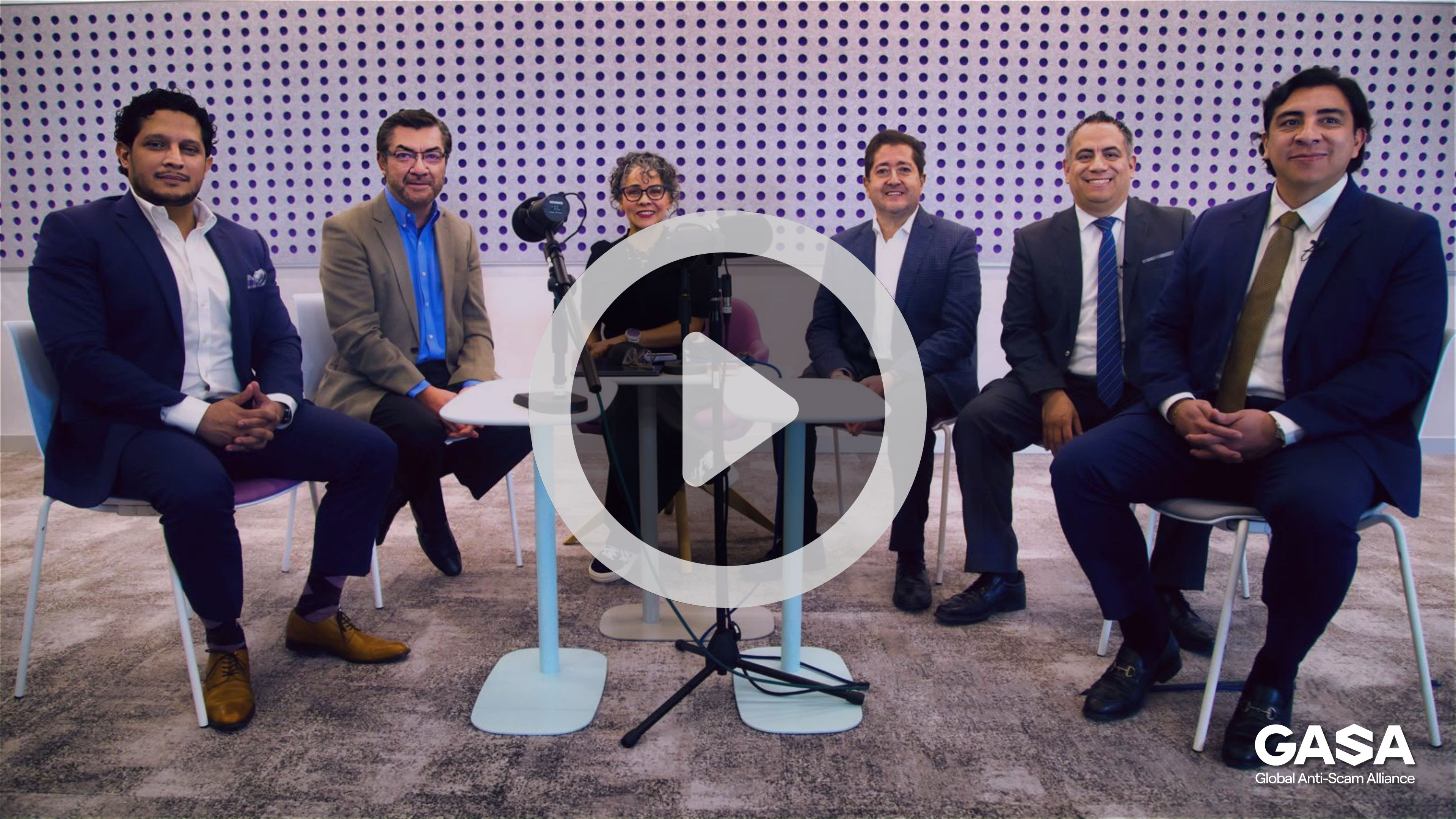
GASA convened the ABM Fraud Committee and Mexican banks to advance the enriched agreement and strengthen coordinated fraud prevention across the sector.