
Regulators, banks, payment providers, law enforcement and civil society agreed practical 30, 60 and 90-day actions to curb scams and fraud across the region.
Africa has connected millions of people to digital money in a short time. The same speed and convenience that drive financial inclusion are now being used against consumers. A single scam can start in one jurisdiction and reach victims on another continent within minutes, moving through several platforms and institutions along the way, and no single institution or country can stop it alone.
The workshop focused on moving from discussion towards practical cooperation. Participants examined emerging fraud and scam trends before working across four areas: balancing fraud prevention with customer experience, cross-border scam response, money mule detection and prevention and the psychological and cultural factors influencing scam behaviours.


A Cross-Sector Coalition Against Scams and Fraud
Participants included the Cyber Security Authority, the Commission on Human Rights and Administrative Justice, GhIPSS, ARB Apex Bank, Akuapem Community Bank, Societe Generale Ghana, Old Mutual Ghana, M-KOPA Ghana, Simbrella Ghana, Tabscrow, the Ghana Internet Safety Foundation, the Internet Society Ghana Chapter, the Anti-Fraud Initiative Ghana (AFIG), Targeted Rights Initiative, Digital Footprints, the British High Commission and the Foreign, Commonwealth & Development Office, among others.
Patricia Eromosele, Director of GASA Africa Chapter, opened the workshop with a call for faster, more practical collaboration across sectors and borders. She was joined by Fabienne Yomsi, Partnership Manager, and Motunrayo Ayo-Akwe, Marketing Manager, who facilitated the working groups.
From Inclusion to Protection: What the Experts Shared
Dr. Jamal Seidu Tonzua, Deputy Director at the Cyber Security Authority (CSA), spoke from the regulator’s side on how Ghana is responding to the rise in scams. He noted that the workshop lined up closely with the theme of this year’s National Cyber Security Awareness Month, which is focused on securing Ghana’s digital financial ecosystem and building trust through collaboration and cyber resilience. He set out the CSA’s mandate: setting and enforcing cybersecurity standards, protecting critical information infrastructure, liaising with law enforcement, and monitoring threats through a national response team, with sector teams for finance and telecommunications already in place. He also pointed to the CSA’s 292 reporting line. Calls to it are triaged and handled together with the police cybercrime unit and other agencies. His central message was that technology must be “development-oriented and human rights-centered,” and that no regulator can tackle scams alone - Government, civil society, the technical community, academia and citizens all have a part to play.

Dr. Robinson Tombari Sibe, CEO and Lead Forensic Examiner at Digital Footprints, showed how fraud is following consumers into the digital economy. Account ownership in Ghana now exceeds 81% of adults, yet Bank of Ghana data shows reported fraud cases rose from 15,865 in 2023 to 16,733 in 2024, with the value at risk climbing from GH¢88 million to GH¢99 million. Most scams, he explained, do not break into systems. They persuade people, then rely on fast payment rails and the silence of victims. His answer was protection by design: friction at the point of risk, verification through a separate trusted channel, mobile money agents trained as a human firewall and one shame-free reporting channel.
Barr. Sam Chigozie Otoboeze, President of the Barr. Sam Otoboeze Foundation, argued that Africa does not mainly lack cybercrime laws. It lacks interoperable capability. Citing the INTERPOL African Cyberthreat Assessment 2026, he noted that 55% of reported cybercrime in Africa is now AI-enabled and reported losses have more than doubled to $484 million. GASA research shows that while 82% of African adults encountered a scam in the past year, only 5% reported it to authorities. He proposed an African Rapid Preservation Network to preserve evidence within six hours and freeze funds within 24.
Isaac Obour, President of the Anti-Fraud Initiative Ghana (AFIG), set out opportunities for stronger cross-sector collaboration, including a coordinated fraud response system that pulls together intelligence from regulators, law enforcement and industry so new scam patterns can be shared quickly. Several working groups built directly on this idea later in the day.
Four Working Groups, Four Problems, One Day
Participants then worked in four facilitated groups, each returning in the afternoon with owners, milestones and 30, 60 and 90-day commitments.
- Balancing fraud prevention with customer experience, presented by Stephen Eshun of Tabscrow and Doreen Raheena Sulleyman of Targeted Rights Initiative
- Cross-border scam response, presented by Barr. Sam Chigozie Otoboeze and Nancy Anim-Addo of M-KOPA Ghana
- Money mule detection and prevention, presented by Kwasi Mensah Nyarko and Fredrica Amoako-Atta of the Ghana Internet Safety Foundation and Michael Agyarko of ARB Apex Bank
- Cyber psychology, culture and scam behaviors, presented by Elvis Amonoo and Randy Osei Pipim of GhIPSS and Seli Gavu of Old Mutual Ghana.
Want to help shape practical anti-scam solutions? GASA Working Groups bring members together to turn shared challenges into real-world action.
Protection Customers Barely Notice
The first group tackled how to stop fraud without frustrating honest customers. It proposed replacing blanket controls with a risk-based approach that profiles customers and businesses by transaction patterns, limits, behaviour and location, so anomalies are flagged early and resolved quickly.
Authentication should work for every user: live face verification for smartphones and USSD-based checks for basic feature phones. To build trust, the group proposed a shared knowledge base for the informal sector, verified trust scores for market businesses and secure escrow that holds payment until goods are delivered.
Doreen Raheena Sulleyman shared Targeted Rights Initiative's training of market women at Mallam Atta Market, which showed traders how to spot a fake mobile money message and to call their provider before ever sharing a PIN. The group's roadmap begins with market education in the first 30 days, adds a friction scoreboard to measure customer experience by 60 days, and introduces a dedicated reporting point with monitoring and evaluation by 90 days.
One Continent, One Response
The cross-border group started from a clear finding: countries are acting in silos, and scammers exploit the gaps. By the time an investigation crosses a border, the money has usually gone.
It proposed an African Cross-Border Anti-Scam Cooperation Framework built on five pillars: legal harmonization, intelligence sharing and coordinated enforcement, technology integration, public-private partnership, and capacity building. Priority actions include a legal gap assessment across countries, a model protocol for evidence preservation and information exchange, a verified directory of national focal points, a standard regional framework for classifying scam incidents and secure channels to share intelligence on suspicious accounts, domains, numbers and wallets. The group also called for joint training in digital forensics and crypto-asset tracing, and multilingual campaigns on how to report.
Breaking the Money Mule Chain
Working in both English and French, the money mule group stressed that a mule is not always a person. Alongside complicit, unwitting and forced individuals, shell companies and high-risk businesses such as casinos can be used to make stolen funds look legitimate.
Participants agreed on clear warning signs: inflows from many international sources, businesses whose scale does not match what they sell, lifestyles that income cannot explain and individuals holding many SIM cards or accounts. Recommendations included machine learning tools that flag mule networks for law enforcement, temporary holds on unusual transactions, and training for two overlooked groups: mobile money vendors and phone repairers. At continental level, the group called for a treaty and a shared vocabulary on mule activity, and flagged sextortion as a fast-growing threat for future work.
The Human Side of Scams
The fourth group looked at why scams work. It identified 12 drivers, from economic hardship and the pull of fast money to high communal trust, media that glamorizes the scam lifestyle, Cybercrime as a Service and transnational scam centers.
The group turned each driver into a recommendation: education that combines anti-fraud awareness with skills and entrepreneurship, year-round media engagement, values championed by families, schools and faith communities, two-factor verification prompts, 24/7 transaction monitoring, stronger national ID systems and dedicated fast-track courts for fraud cases. Above all, it called for victims to be destigmatized so that more people report
A Shared Agenda for the Region
Although each group worked on a different problem, the conclusions converged. Participants identified implementable actions around reporting that is simple and shame-free, real-time intelligence sharing between institutions, response times that match the speed of scammers, protection that reaches feature phone users and the informal sector, common standards across borders and stronger skills for investigators and prosecutors.
Sustaining the Momentum
The Trust & Safety Workshop in Accra showed what becomes possible when regulators, financial institutions, payment providers, law enforcement and civil society work on the same problems at the same table. The discussions confirmed that the biggest barriers to curbing scams and fraud sit between organizations, sectors and countries: slow cross-border response, fragmented reporting, inconsistent legal definitions and intelligence that does not move as fast as stolen funds.
Participants identified implementable actions for continued work. These include risk-based protection that reaches every user, from smartphones to basic feature phones; a cross-border cooperation framework with shared standards and rapid evidence preservation; trusted, real-time intelligence sharing; earlier detection and disruption of money mule networks; simple, shame-free reporting channels; and prevention approaches built around the people and communities most at risk.
Continue the Conversation Across Africa
GASA Africa Chapter brings together organisations across sectors to strengthen collaboration against scams and support coordinated action across the continent.

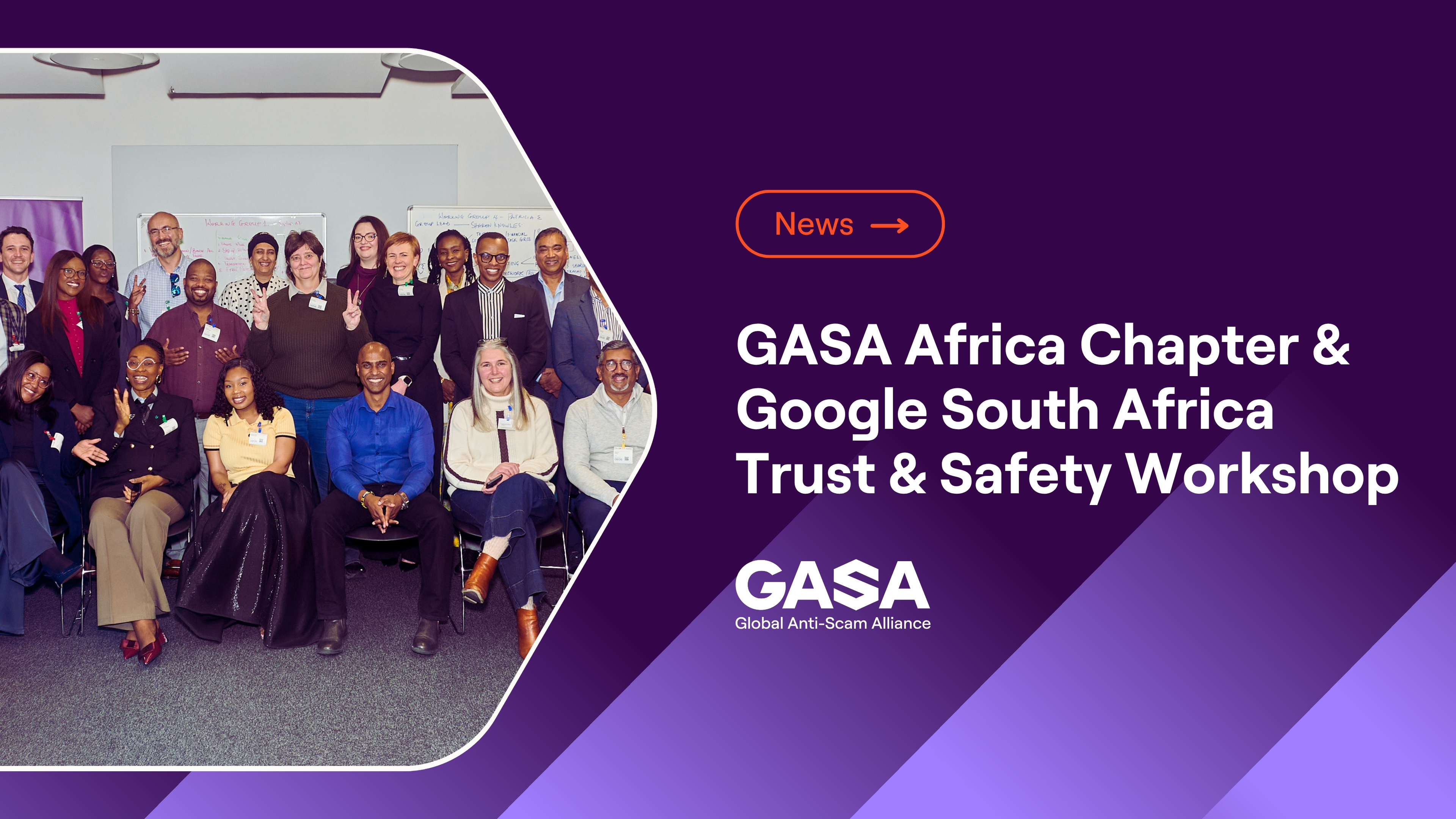
Accra Trust & Safety Workshop Turns Collaboration into Action Against Scams and Fraud in West Africa
GASA Africa Chapter and Google South Africa brought anti-fraud leaders together to strengthen cross-border cooperation and scam prevention.
State of Scams in Nigeria 2026: A Comparative Review Across Africa
Nigerian experts examine scam trends, technology, consumer protection and the need for stronger cross-sector collaboration.
State of Scams in Kenya 2026: A Comparative Review Across Africa
Kenyan experts examine scam trends, data sharing, digital trust and the need for stronger cross-sector prevention.
State of Scams in South Africa 2026: A Comparative Review Across Africa
South African experts examine scam trends, AI, consumer protection and the need for stronger cross-sector collaboration.
GASA and Google Trust & Safety Workshop Sets Priorities for Anti-Scam Cooperation Across Africa
GASA Africa Chapter and Google South Africa brought anti-fraud leaders together to strengthen cross-border cooperation and scam prevention.
What Uganda’s IVR Trial Shows About Practice-Based Scam Prevention
A Uganda IVR trial shows how practice-based fraud prevention helped mobile money users reduce losses and increase reporting.
Protecting Seniors and Vulnerable Communities from Fraud
Experts from financial services, internet safety and policy explore how families, banks and communities can better protect vulnerable groups from fraud.
Beyond Compliance: Why Organisational Accountability is Critical for Consumer Protection
How the NDPC-Meta initiative could strengthen data protection, organisational accountability, scam prevention and consumer trust across Nigeria’s digital economy.