
The Global Anti-Scam Summit Europe 2026 took place on the 9th and 10th of June at Convento do Beato in Lisbon, bringing together more than 800 participants from over 460 organisations across government, law enforcement, regulation, financial services, technology, telecoms, consumer protection, academia and civil society. Under the theme Europe Against Scams: Public-Private Partnerships in Action, the Summit focused on how cross-sector cooperation can strengthen scam prevention, disruption, intelligence sharing, enforcement and victim protection.
The programme combined plenary discussions, workshops, working group meetings, sectoral sessions and the Scam Fighter Awards. Workshops led by Bitdefender, Outseer, ScamAdviser, GSE, the Linux Foundation, Visa and Meta examined trusted channels, AI-enabled detection, consumer education, signal sharing, shared defence infrastructure, multi-rail payment risk and industry commitments.
That cross-sector focus reflects how scams now operate. A single scam can begin with a fake advertisement, continue through a messaging app or phone call, move through a payment rail and end with funds routed through mule accounts or cross-border criminal infrastructure. No one organisation sees the full picture. Public-private partnerships are needed because scammers already operate across the boundaries that legitimate institutions often struggle to cross.
Highlights from the Summit, including plenary discussions, workshops, working group meetings, sectoral sessions and the Scam Fighter Awards, are available in the photo gallery.
Public-Private Partnerships Must Reflect the Full Scam Chain
A consistent message across the Summit was that scams cannot be addressed as isolated incidents, consumer mistakes or single-channel fraud events. They move through a chain of digital, financial, telecom and human touchpoints. Prevention therefore needs to be designed around the full scam journey, not only the first contact or the final transaction.
Platforms may see fake accounts, impersonation, scam content or fraudulent advertising. Telecom providers may see number abuse, spoofing or suspicious messaging patterns. Financial institutions may see the payment, the mule account or the unusual transaction behaviour. Law enforcement may see linked criminal networks. Victim support organisations may see the personal and social impact.
The value of public-private partnership lies in connecting these roles before harm becomes irreversible. When each sector acts only within its own boundary, scammers can move through the gaps between systems.
 Towards Stronger Global Coordination: What Happened at the Global Fraud Summit
Intelligence Sharing Is Moving From Principle to Practice
Intelligence sharing was one of the strongest operational themes at the Summit. The discussions moved beyond general calls for collaboration and focused on how scam signals can be exchanged in ways that are timely, lawful, proportionate and useful.
This is not simply a matter of sharing more data. Effective intelligence sharing depends on identifying the signals that can help partners act earlier. These may include scam domains, phone numbers, account indicators, behavioural patterns, typologies, infrastructure signals or information about how criminal activity is moving between platforms, telecoms and financial services.
Feedback loops are also essential. If one organisation shares a signal, it should be possible to understand whether that signal supported takedown, further detection, investigation or victim prevention. Without feedback, partnerships risk becoming one-way reporting channels. With feedback, they become learning systems that improve over time.
Enforcement Needs Trusted Public-Private Channels
The enforcement discussions showed that practical cooperation depends on trusted channels between law enforcement, public authorities and private-sector partners. Scam networks move quickly, often across jurisdictions, and enforcement action may require timely information from banks, platforms, telecom providers, registrars and other infrastructure actors.
This type of cooperation depends on clarity and trust. Private-sector partners are often first to see suspicious activity, while law enforcement has the authority to investigate, connect cases and take formal action. Partners need to know what information is useful, how it will be handled, who can act on it and what outcomes are possible.
Public-private partnerships also help move enforcement upstream. Instead of responding only after individual victims report losses, coordinated disruption can target the infrastructure, accounts, channels and networks that enable repeat harm.
Regulation Can Enable Coordinated Action
The policy and regulator sessions showed that public-private partnerships need clear legal and regulatory conditions to work effectively. Organisations may want to collaborate, but uncertainty around data protection, liability, reporting duties and sector-specific obligations can slow action.
This matters because scams do not begin and end at the payment stage. A victim may be targeted through a fake advertisement, search result, social media profile, messaging channel or phone call long before a payment is made. If policy focuses only on the final transaction, earlier points of manipulation may remain unaddressed.
Public-private partnerships can help regulators and industry identify these gaps. They can also support more practical approaches to reporting, reimbursement, victim support and cross-sector responsibility. Regulation provides the framework, but partnerships help test whether that framework works in the real scam environment.
Shared Defence Requires Common Infrastructure
Many organisations already invest in detection, authentication, customer monitoring, warnings and investigation support. The larger gap is how these capabilities connect across the ecosystem.
Shared defence may involve standardised fraud data models, common typologies, privacy-preserving signal exchange, trusted reporting pathways and federated learning. These approaches can help organisations collaborate without exposing unnecessary personal data or weakening privacy protections.
This is particularly important for smaller institutions. Large organisations may have mature fraud teams, advanced analytics and extensive data science capacity, while smaller banks, payment service providers and platforms may not. If intelligence remains fragmented, criminals can exploit the weakest link.
A public-private partnership model can help create a community-level view of scam activity. It allows partners to detect patterns that may not be visible inside one organisation and to act before the same infrastructure, typology or criminal network harms more victims.
AI Is Changing Both Scam Tactics and Detection
The Summit showed that AI is changing both scam operations and scam prevention. Fraudsters are using automation, synthetic content, voice cloning, deepfakes and more adaptive social engineering to make scams faster, cheaper and more convincing.
This has clear implications for public-private partnerships. AI-enabled scams do not stay within one platform, bank or communication channel. Detection models therefore need better signals, shared typologies and faster feedback from other parts of the ecosystem.
Trusted Channels Can Become Scam Infrastructure
This creates a public-private partnership challenge. The organisations that operate trusted channels may see signs of abuse before financial loss occurs, while financial institutions may see risk only once a payment is attempted. Telecom providers, platforms, cybersecurity companies, banks and law enforcement therefore need mechanisms to connect early indicators with later-stage harm.
Stronger prevention depends on treating trusted channels as part of the scam chain, not as separate from it.
Payment Risk Needs a Multi-Rail View
Visa’s workshop, Beyond the Blind Spots: Taking a Holistic, Multi-Rail Approach to Risk, showed why scam prevention cannot be limited to one payment channel or product. Victims experience scams as a sequence of events, while institutions often see only the part of the journey that touches their system.
For public-private partnerships, this means connecting payment intelligence with signals from platforms, telecoms, messaging services and law enforcement. A suspicious payment may be the final visible step in a scam that began much earlier.
Technology Companies Are Building Shared Commitments
Meta’s workshop, Industry Accord in Action, showed how technology companies are developing shared commitments around prevention, cooperation, resilience and public awareness.
This matters because scam networks do not limit themselves to one platform. They test policies, move accounts, reuse infrastructure and shift users between services. Shared commitments can help create a stronger baseline across the technology sector, while still leaving room for companies to apply controls that fit their own products and risk profiles.
For public-private partnerships, the key is whether these commitments lead to practical cooperation, better signal sharing and faster disruption when scam activity moves across services.
Platforms, Banks and Telecoms Need Complementary Roles
The sectoral discussions showed that platforms, banks and telecoms each hold different parts of the scam picture. The issue is not whether one sector can solve the problem alone, but how each sector’s signals and controls can support the others.
These signals become more useful when connected. A bank may not see the grooming that took place before a payment. A platform may not see the financial loss that follows an interaction. A telecom provider may detect suspicious number activity without knowing whether it is linked to scam payments. Law enforcement may see links across cases but need private-sector intelligence to act quickly.
The Summit also showed that collaboration must be operationally realistic. Partners need to manage false positives, privacy requirements, customer friction, appeal routes and evidential standards. Public-private partnerships are useful because they allow these constraints to be understood before fast action is needed.
Consumer Protection Must Be Timely and Specific
The consumer education discussions challenged the idea that awareness alone is enough. Scammers use urgency, authority, fear, intimacy and social pressure in targeted ways. Generic warnings often fail because they do not appear at the moment when a person is under pressure or about to act.
Public-private partnerships are important because consumers encounter scams across different parts of the ecosystem. Banks, platforms, telecom providers, public authorities and consumer organisations all interact with people at different stages of risk.
Victim Protection Must Stay Central
Public-private partnerships often focus on systems, signals and institutional coordination, but the Summit also showed why victim protection must remain central. This was clearest in the Day 2 plenary discussion on scam compounds, which examined the overlap between online scams, organised crime, human trafficking, forced labour and abuse.
This human rights dimension matters for prevention, enforcement and recovery. A purely infrastructure-focused response can miss the people trapped inside criminal operations, as well as the long-term impact on victims of fraud. Victims may experience financial loss, shame, fear, stress, isolation and loss of trust.
Victim-centred design has practical implications. Reporting pathways need to be clear and accessible. Frontline staff need to respond without increasing shame or distress. Recovery processes need to recognise emotional harm as well as financial loss. Prevention measures need to account for the psychological pressure used by scammers.
Public-private partnerships should include these perspectives from the start. A model that disrupts infrastructure but does not improve the victim journey remains incomplete.
Working Groups Turn Partnership Into Practice
The Summit showed that public-private partnerships become more useful when they are linked to defined activity. GASA’s Working Groups provided a structure for moving from shared concern to practical work.
This structure matters because collaboration can otherwise remain abstract. Working groups create space to test ideas, build trust, define outputs and maintain momentum between summits.
Public-private partnerships need this kind of continuity. They cannot rely only on individual events, informal relationships or emergency escalation. They need practical projects, accountable participants and continued engagement.
Partners Reflected the Cross-Sector Model
The Summit was supported by organisations working across technology, cybersecurity, consumer protection, financial services, intelligence sharing and fraud prevention, including Amazon, Bitdefender, Meta, Outseer, ScamAdviser, Visa, Deco Proteste, Euroconsumers, GSE, ThreatFabric, CUBE AI, Feedzai, Google and TrendLife.
Their involvement helped reflect the Summit’s central message: scams cannot be addressed by one sector alone. Effective public-private partnerships depend on bringing together the organisations that see different parts of the scam chain and can act at different points in the victim journey.
Scam Fighter Awards Recognised Excellence
The Scam Fighter Awards recognised excellence across five categories, highlighting initiatives that help prevent, detect, disrupt and respond to scams.
Together, the winners and runner-ups reflected the breadth of excellence across the anti-scam ecosystem, from consumer protection and victim support to intelligence sharing, policy coordination, investigation and technology-enabled disruption. GASA congratulates all winners, runner-ups and nominees for their contribution to the fight against scams.
The Scam Fighter Awards will continue at upcoming GASA summits, including the Global Anti-Scam Summit America 2026 in San Francisco on 2 and 3 September.
What Public-Private Partnerships Need to Deliver
The Global Anti-Scam Summit Europe 2026 demonstrated that public-private partnerships are now a practical requirement in the fight against scams. The question is no longer whether collaboration is needed, but how it can be structured so that it produces faster, safer and more consistent action.
Effective partnerships need clear goals, trusted channels, lawful intelligence sharing, feedback loops, defined roles and measurable outcomes. They also need to recognise the constraints faced by different sectors and the experience of victims. Without these elements, collaboration can remain too slow, too informal or too disconnected from the points where harm occurs.
Scammers already operate as networks. The response needs to become more connected, more coordinated and more capable of acting across the full scam chain. Public-private partnerships provide one of the clearest route towards that goal.

Global Anti-Scam Summit America 2026: Highlights, Insights and Resources
Explore GASS America 2026 highlights and insights, with the Summit summary, photos, presentation slides, transcripts and session recordings from San Francisco.
State of Scams in Kenya 2026: A Comparative Review Across Africa
Kenyan experts examine scam trends, data sharing, digital trust and the need for stronger cross-sector prevention.
State of Scams in South Africa 2026: A Comparative Review Across Africa
South African experts examine scam trends, AI, consumer protection and the need for stronger cross-sector collaboration.
-3.jpg)
More than one in five adults in Japan encountered scams in the past year
New State of Scams Japan 2026 report examines how scams are reaching consumers and where stronger prevention and collaboration can make a difference
GASA Brings Stakeholders Together in Brussels for First Europe Chapter Meeting
GASA Europe brings 50+ stakeholders together in Brussels to discuss scam trends, data sharing and cross-sector priorities.

Research Working Group Meeting: Fraudulent Tickets and Robocall Scam Tactics
Research presented to GASA examines consumers’ ability to spot fraudulent tickets and tactics found across 4.49 million scam and spam robocalls.
-2.jpg)
Fighting Fraud Without Borders: Cross-Regional Collaboration in Latin America and Beyond
A roundtable at GASS America examined cross-regional collaboration in Latin America and beyond, focusing on fraud prevention, consumer protection and response.
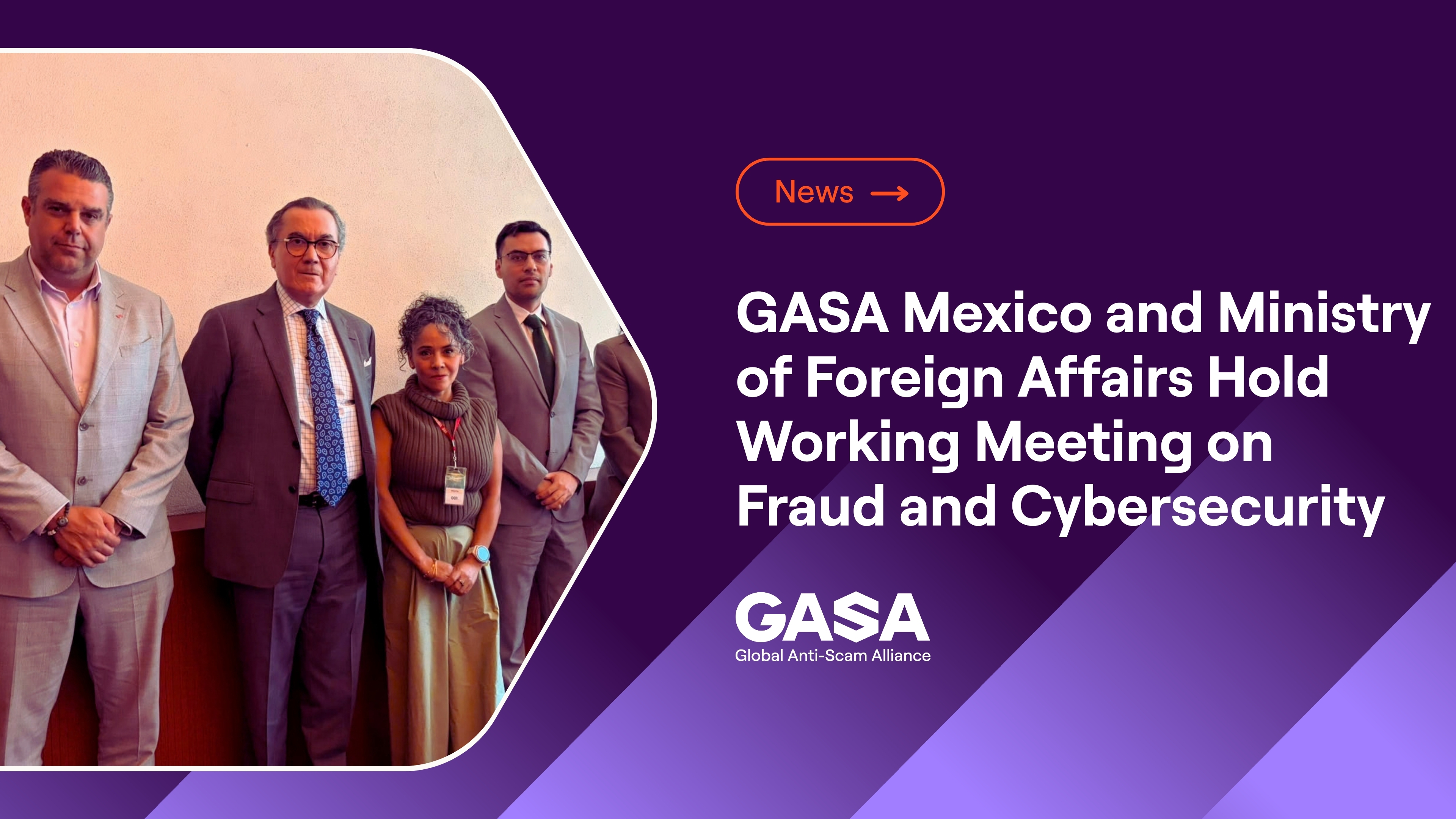
GASA Mexico and the Ministry of Foreign Affairs Hold Working Meeting Ahead of the Chapter’s Annual Forum, “From Coalition to Action”
GASA Mexico and the Ministry of Foreign Affairs convened Mastercard and Scotiabank to discuss fraud, cybersecurity, information sharing and emerging technologies.