

Scams now operate at scale across platforms, payment systems, and telecommunications infrastructure. Criminal groups exploit gaps between public and private sectors, which limits the impact of isolated regulatory, enforcement, or technical responses.
Global research into scam prevalence and reporting highlights the structural nature of the challenge. Findings from GASA’s Global State of Scams reports show that while scam exposure is widespread, reporting remains fragmented, with victims often unsure where to turn or sceptical that reporting will lead to action. This reflects the reality that responsibility for prevention, reporting, and response is split across public bodies and private-sector organisations, highlighting weaknesses that scammers are quick to take advantage of.
Together, these findings point to a coordination challenge rather than a lack of vigilance. Responsibility for prevention, detection, enforcement, and victim support is distributed across sectors, creating systemic gaps that scammers exploit.
Public–Private Partnerships provide a way to address this fragmentation by aligning responsibility, intelligence, and action across organisations involved at different points in the scam lifecycle .
This framing underpins international policy discussions, including those taking place at the Global Fraud Summit in Vienna on 16–17 March 2026, where GASA will be participating alongside public and private sector stakeholders examining how collaboration can be formalised and sustained.
Why Single-Sector Responses Fall Short
Public authorities are responsible for setting rules, investigating crime, and coordinating internationally. Private-sector organisations , meanwhile, operate or protect much of the infrastructure scammers abuse, including platforms, payment rails, and telecommunications networks.
When these actors operate separately, gaps emerge. Law enforcement may only see cases once harm has occurred. Financial institutions may detect suspicious transfers without insight into the deception that prompted them. Platforms may identify misuse patterns but be limited to interventions within their own services. Public–Private Partnerships help bridge these fragmented perspectives, enabling more coordinated prevention and response.
Public–Private Partnership as an Operating Model
Across policy and practitioner discussions, Public–Private Partnerships are increasingly treated as an operating model rather than a single initiative. This places emphasis on sustained collaboration between public authorities and private-sector organisations, clarifying roles, improving coordination, and supporting more consistent responses to scam activity.
Every scam will cross multiple platforms and frequently multiple jurisdictions. This means that no one actor can effectively detect, disrupt and go after scammers. This is why strategic public-private partnerships in the spirit of joint trust and collaboration are fundamental to scam prevention and enforcement, and why without them we will be rapidly outclassed by the highly sophisticated organised crime groups responsible for this awful crime.
Andrei Skorobogatov
Director of Policy, Global Anti-Scam Alliance
These elements are interdependent. Standalone measures may help in one area while leaving gaps elsewhere. A partnership model supports a coherent system in which policy, technology, enforcement, and consumer protection reinforce each other rather than operating in parallel.
Lessons from Sustained Cross-Sector Discussion
Sustained discussion across international forums, including industry and cross-sector forums such as GASA’s Global Anti-Scam Summits , reinforces several practical lessons about what makes partnerships effective.
Some of the most effective partnerships are operational , with information sharing structured in forms that can be acted on quickly. Others focus on strategic coordination, shared threat intelligence, or longer-term alignment across sectors. In practice, partnerships require broad cross-sector participation, since uneven defences tend to displace scams rather than reduce them.
Successful partnerships also remain adaptive . Scam tactics evolve rapidly, and partnership models need mechanisms to update processes, expand participation, and incorporate new tools without undermining trust.
Networked Threats Require Networked Responses
Scam operations function as distributed networks . Countering them requires responses that are connected across sectors and borders, combining operational action with shared intelligence and strategic coordination.
By linking authority, operational visibility, and technical capability, Public–Private Partnerships support earlier intervention, more informed decision-making, and more effective disruption of scam activity, without relying on centralised control.
Closing Perspective
Global research, practitioner experience, and current international policy discussions point to the same conclusion. Public–Private Partnerships are no longer an emerging concept in scam prevention. They are a practical requirement for reducing harm at scale.
The challenge now lies in design and delivery, building partnerships that are trusted, governed, and capable of adapting to an evolving threat landscape.
Sign up to the GASA newsletter for regular updates on scam prevention, research, and best practices.
About the Author
James Greening is a Digital Content Manager at the Global Anti-Scam Alliance (GASA), where he writes on cyber-enabled fraud and developments in the global fight against online scams. He previously founded Fake Website Buster, a project dedicated to identifying and raising awareness of fraudulent websites.
FTC’s Never EVER Campaign Helps Prevent Elder Financial Abuse With Simple, Specific Scam Warnings
The FTC’s Never EVER campaign uses simple, specific imposter scam warnings to help prevent elder financial abuse and support coordinated consumer education.
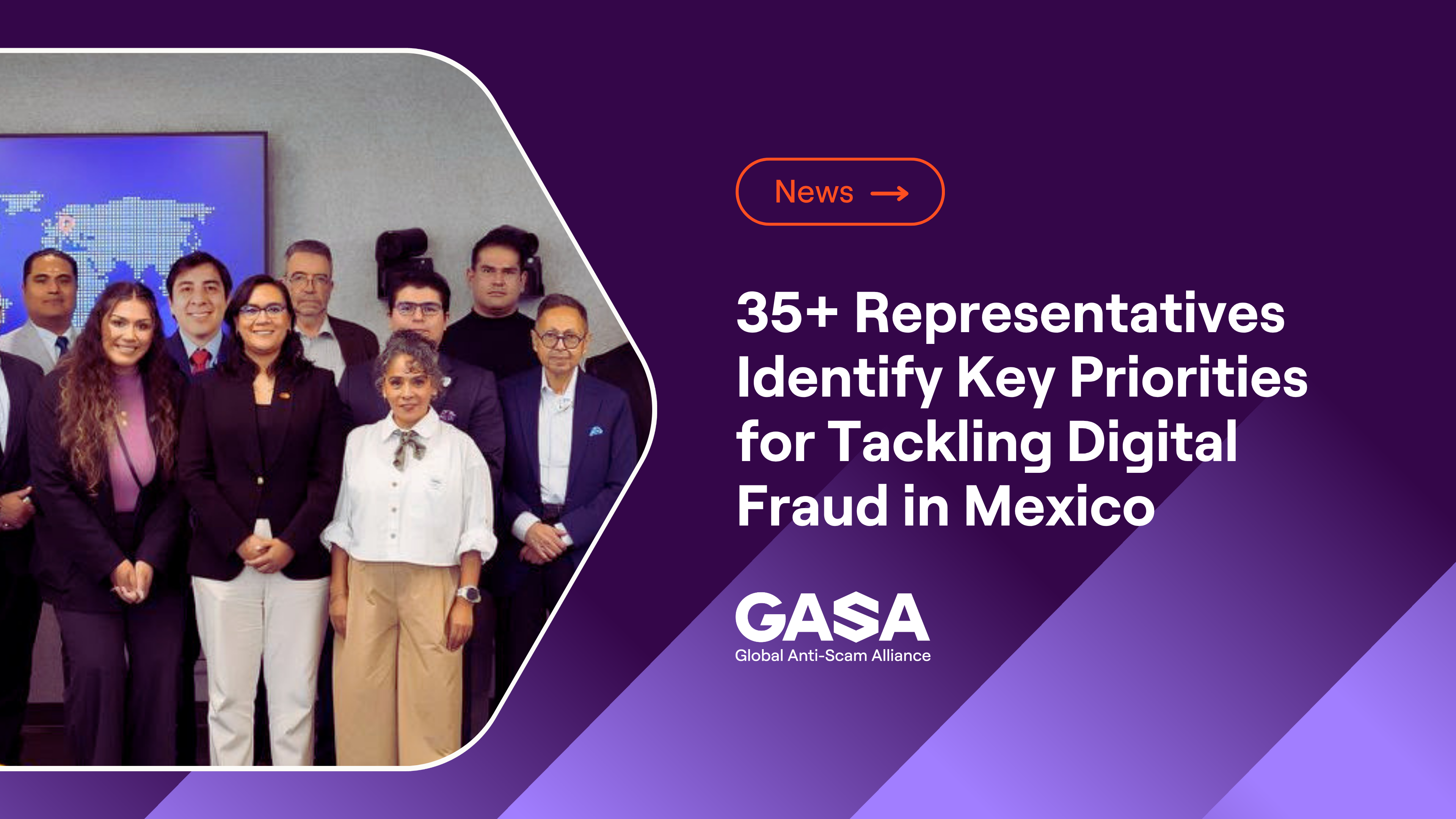
GASA Mexico's Second Roundtable Advances Coordinated Action Against Digital Fraud
GASA Mexico's second roundtable brought together more than 35 representatives to strengthen coordination across cybersecurity, fraud prevention and other sectors.

Cognyte Joins Global Anti-Scam Alliance to Fight Financial Fraud Threats
Cognyte, a global leader in investigative analytics software, today announced its membership in the Global Anti-Scam Alliance (GASA).

A network is beaten by a network: Mexico's banks move from remediation to prevention
GASA convened the ABM Fraud Committee and Mexican banks to advance the enriched agreement and strengthen coordinated fraud prevention across the sector.

Una red se combate con una red: la banca mexicana avanza de la remediación a la prevención
GASA reunió al Comité de Fraudes de la ABM y a bancos mexicanos para avanzar el convenio enriquecido y fortalecer la prevención coordinada del fraude.
Appeals Centre Europe Report Points to Gaps in Social Media Scam Moderation
Appeals Centre Europe’s Transparency Report, covering April 2025 to March 2026, highlights early fraud and scam dispute findings relevant to social media moderation and scam prevention.

Protecting Seniors and Vulnerable Communities from Fraud
Experts from financial services, internet safety and policy explore how families, banks and communities can better protect vulnerable groups from fraud.
Fenasbac and GASA Report Outlines a Cross-Sector Response to Digital Scams in Brazil
Fenasbac and GASA’s Brazil Blueprint examines how finance, telecoms, technology and regulators can share intelligence to strengthen protection against digital scams.