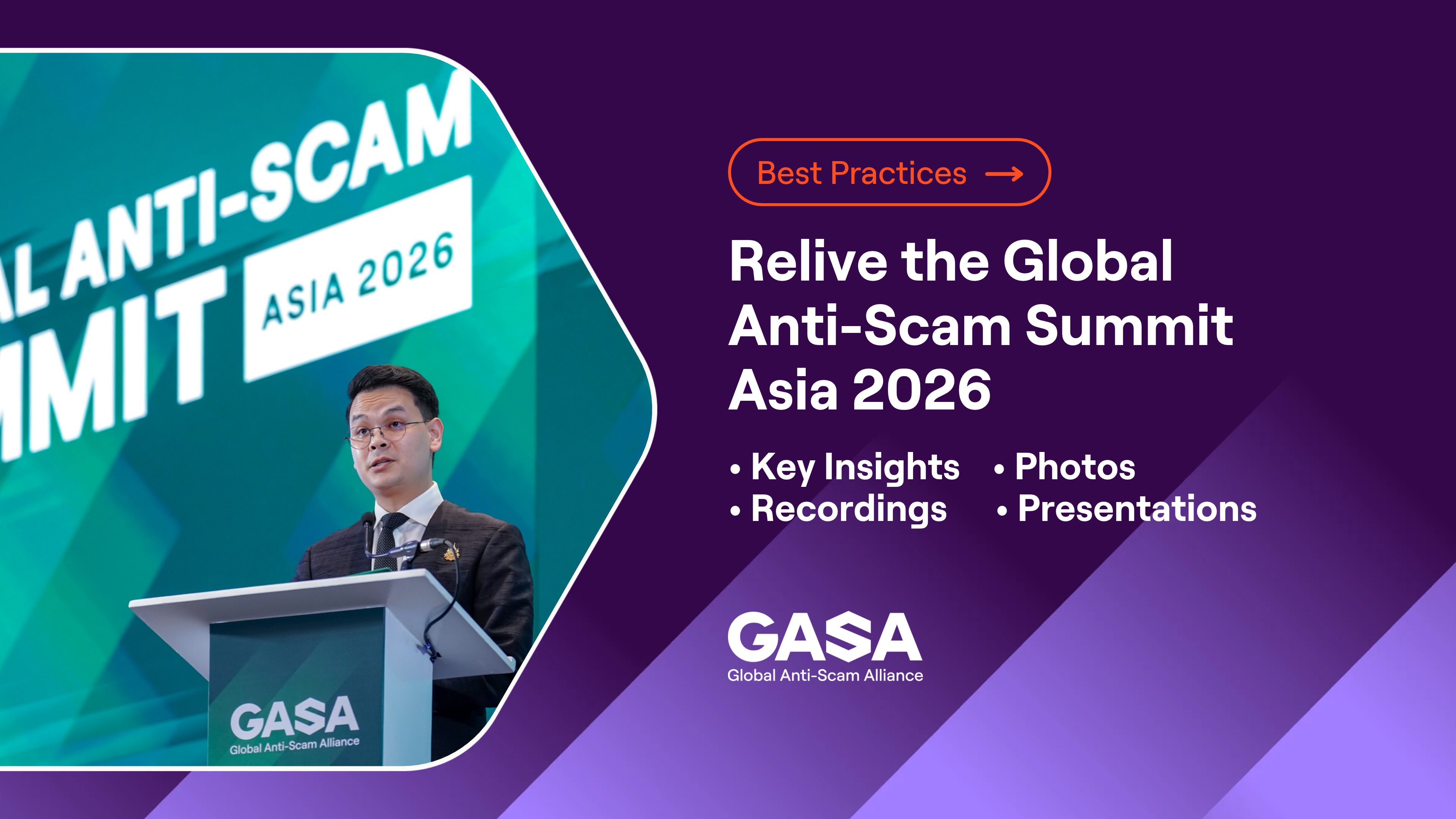
Global Anti-Scam Summit Asia 2026: Highlights, Insights and Resources

Global Anti-Scam Summit Asia 2026

The Global Anti-Scam Summit Asia 2026 brought together more than 1,130 participants in person and online on 10–11 November at Pullman Bangkok King Power in Thailand.

Under the theme Asia’s Leadership Against Scams, the Summit featured 100+ speakers from government, law enforcement, financial services, technology, telecoms, consumer protection and civil society.

The Summit was co-hosted by Thailand’s Ministry of Digital Economy and Society, the Royal Thai Police, the Bank of Thailand and the Securities and Exchange Commission, Thailand.

Ahead of the Summit, participants visited the Royal Thai Police Anti-Cyber Scam Center to learn about Thailand’s response to online scams.

Across two days, discussions examined the human impact of scams, how banks and telecom providers can intervene earlier and how AI is changing scam tactics and detection. Speakers also explored how organisations can share intelligence, trace stolen funds, disrupt scam networks across borders and support victims and survivors. On day two, participants took part in six working groups: Consumer Education, Enforcement, Research, Data Integrity, Intelligence Sharing and Prevention & Intervention.

Explore the Summit’s key takeaways, watch the highlights from Bangkok, browse the photo gallery and revisit the full Main Stage sessions on demand.

Main Stage presentation slides are at the end of this article.

Keynotes From Thai Leaders

In his opening keynote, H.E. Chaichanok Chidchob, Thailand’s Minister of Digital Economy and Society, outlined how Thailand coordinates scam reporting and freezes suspicious accounts. He called for faster cross-border intelligence sharing to help authorities stop illicit transfers.

In the day one closing keynote, Senator Niwes Phancharoenworakul outlined how Thailand’s Senate is examining potential changes to anti-scam laws. He called for closer coordination between government agencies and better public education to help people recognise and avoid scams.

State of Scams in Asia 2026

The Summit opened with findings from GASA’s State of Scams in Asia 2026 report, based on a survey of 17,460 adults across 13 Asian countries.

The research found that 71% had encountered a scam in the past year. Of those who encountered one, 62% interacted with a scammer. The report estimated regional losses at US$136.5 billion and found that 72% of scam victims reported an impact on their mental wellbeing.

Key Takeaways From Bangkok

The sessions in Bangkok examined where organisations can intervene, from the first suspicious call or message to the movement of stolen funds. Speakers also discussed what victims and survivors need after the immediate threat has passed.

Build safeguards into the services people already use

Telecom operators discussed screening suspicious calls and texts at network level, while payment providers examined how to warn customers before they send money. Speakers also explored how AI could recognise signs of manipulation, such as pressure to pay quickly or keep a transfer secret.

Consumer education sessions highlighted scenario-based training in Fiji and multilingual community programmes. Speakers called for measuring whether those efforts change how people respond when they encounter a scam.

Target the infrastructure that keeps scam networks running

Speakers described how scam compounds can relocate or split their operations across countries after a crackdown. The Financial Action Task Force session examined how tracing scam proceeds can help authorities target the shared services and infrastructure that criminal networks depend on.

The cryptocurrency discussion illustrated where investigators need help from industry. Blockchain records can help trace stolen funds, while exchanges can help identify who controls a wallet. A freeze can stop the funds from moving again, and returning them to victims requires further coordination.

Give organisations a clear way to act on shared intelligence

The comparison of national anti-scam models highlighted the value of clear leadership and defined roles for police, financial institutions, telecom providers and digital platforms. For cross-border cases, speakers called for designated contacts and secure channels for sharing evidence. A Singapore police officer described how a trusted contact in Cambodia helped recover money for a scam victim.

The Global Signal Exchange session offered another example. Reports submitted through Scam.org now feed into the exchange so partners can act on them. GovTech Singapore described how sharing information about scam websites helped partners take them down, and TikTok announced that it had joined the exchange.

Build victim support into the response

Breakout speakers called for clear referrals so people who report a scam can get timely guidance and support without stigma. They also highlighted the need for reporting and prevention resources that reflect the languages and circumstances of the communities they serve.

For people trafficked into scam compounds, speakers stressed the need for continued psychological, legal, financial and social support after rescue. That support should reflect each survivor’s circumstances and give them choices about their recovery.

A warning has to reach someone before they pay, investigators need to act before stolen funds move again and people who report a scam need a clear route to help.

Scam Fighter Awards

The Scam Fighter Awards recognized organizations developing practical approaches to scam prevention, detection, disruption and consumer protection.

The winners of the Scam Fighter Awards at the Global Anti-Scam Summit Asia 2026 were:

  • Best Awareness Campaign or Educational Programme

    Department of Migrant Workers

  • Best Cross-Sector Collaboration

    Gogolook

  • Best Investigation or Research

    Humanity Research Consultancy

  • Best Policy or Regulatory Initiative

    Central Bank of the UAE

  • Best Technological Solution

    Indosat Ooredoo Hutchison

Building on a Global Conversation

Bangkok was the third and final stop in GASA’s 2026 Global Anti-Scam Summit programme, following Lisbon on 9–10 June and San Francisco on 2–3 September. The Bangkok Summit brought perspectives from across Asia to the discussions on earlier intervention, intelligence sharing and cross-border enforcement.

Global Anti-Scam Summit Europe 2027

Next Stop: Amsterdam

The global Summit programme continues on 12–13 May 2027 with the Global Anti-Scam Summit Europe 2027 at the Johan Cruijff Arena in Amsterdam.

Under the theme The 5-Year Framework, the Summit will bring together leaders from government, law enforcement, industry and civil society to continue developing practical approaches to scam prevention and disruption.

Access Additional Global Anti-Scam Summit Asia 2026 Materials

Access the Main Stage presentation slides from the Global Anti-Scam Summit Asia 2026.

Sign up for the GASA newsletter to receive regular updates on scam prevention, research, and best practices.

Continue reading

Log in to access the Main Stage presentation slides.

Nov 26, 2026
7 minute read
Category
Research News Best Practices Industry - National Cyber Security Centers (NCSCs) Industry - Telecom Operators / Hosts Topic - Scam Reporting Topic - Fraud Prevention Topic - Data Sharing Region - Global Video Scam Trends Presentations Topic - Fraud Policy Topic - Fraud Research Industry - Law Enforcement Industry - Financial Authorities Region - Asia-Pacific Industry - Registries / Registrars Industry - Policy Makers Industry - Big Tech / Social Media Topic - Scam Prosecution & Enforcement Industry - Consumer Protection & Authorities Chapter - Indonesia Chapter - Oceania Chapter - Philippines Chapter - Singapore Chapter - Thailand Event - GASS Asia 2026 Working Groups
Written by
Global Anti-Scam Alliance (GASA)
Share article

Latest blogs & research

Relive the Global Anti-Scam Summit Asia 2026

Global Anti-Scam Summit Asia 2026: Highlights, Insights and Resources

Explore highlights from the Global Anti-Scam Summit Asia 2026 in Bangkok, watch full Main Stage sessions and discover key findings from the State of Scams report.
Research News Best Practices Industry - National Cyber Security Centers (NCSCs)
State of Scams Malaysia 2026

State of Scams Malaysia 2026: New Report Sets Out 13 Recommendations to Strengthen Collective Action Against Scams

Global Anti-Scam Alliance, Mastercard and Whoscall release new report finding that 83% of Malaysian adults encountered a scam in the past year, with 14% losing money.
Research Topic - Fraud Research Region - Asia-Pacific
Recognising excellence in combating scams at the Scam Fighter Awards in Asia

Meet the Winners – Scam Fighter Awards at the Global Anti-Scam Summit Asia 2026

Meet the five Scam Fighter Awards winners and runners-up from the Global Anti-Scam Summit Asia 2026 in Bangkok, and see which initiatives were recognised.
News Topic - Data Sharing Topic - Scam Awareness Region - Global
state of scams in hong kong 2026

Whoscall, GASA and Mastercard Release the 2026 Asia Scam Report: Hong Kong

More Than 80% of Hong Kong Respondents Encountered Scams; Phone Calls and SMS Remain the Leading Channels
Research Scam Trends Topic - Fraud Research Region - Asia-Pacific
State of Scams in Asia - 2026 Report

71% of Adults Surveyed Across 13 Asian Markets Encountered Scams, with Estimated Losses of US$136.5 Billion

This study of 17,460 adults across 13 Asian markets shows that scam exposure is widespread, with 71% of participants encountering a scam in the past year. While 66% say they are confident in recognizing scams, 62% of those exposed went on to interact with a scammer. Ultimately, 9% lost money or personal information that led to financial loss, while only 4% reported a scam to the authorities. The findings highlight a significant gap between perceived scam awareness and real-world resilience.
Report News Scam Trends Topic - Fraud Research
State of Scams in the Philippines - 2026 Report

Building a More Trusted Digital Philippines: New Report Underscores the Need for Collective Action as Scam Exposure Continues to Rise

GASA’s State of Scams in the Philippines 2026 Report, in collaboration with Mastercard and Gogolook, highlights the growing scale of the scam challenge in the Philippines.
Research Scam Trends Topic - Fraud Research Industry - Financial Authorities
State of Scams in Japan - 2026 Report

More than one in five adults in Japan encountered scams in the past year

New State of Scams Japan 2026 report examines how scams are reaching consumers and where stronger prevention and collaboration can make a difference
Research Scam Trends Topic - Fraud Research Region - Asia-Pacific

GASA and Whoscall Release 2026 Asia Scam Report – Taiwan

The 2026 Asia Scam Report – Taiwan, provides an in-depth look at scam exposure, channels, victim experiences, and scam awareness among people in Taiwan.

Research Industry - Telecom Operators / Hosts Scam Trends Region - Asia-Pacific