
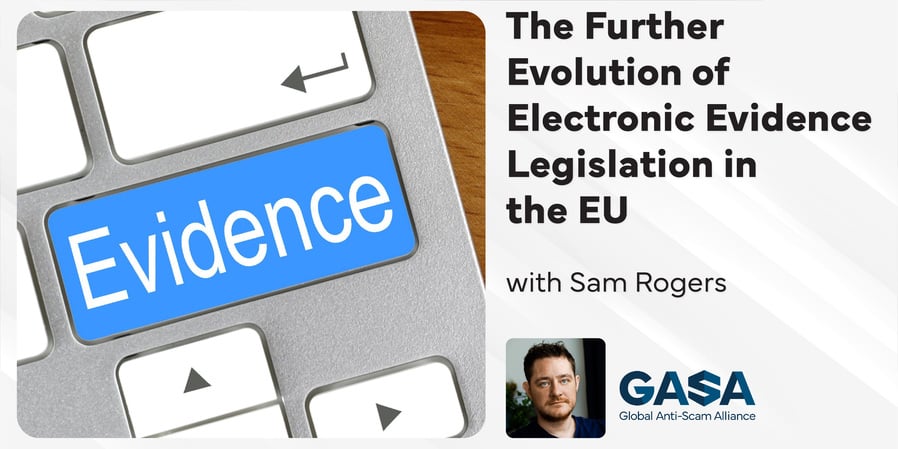
European Production and Preservation Orders arrive with Regulation (EU) 2023/1543 and Directive (EU) 2023/1544
Author: Sam Rogers, Marketing Director, Global Anti-Scam Alliance
The rapid advancement of technology has transformed the world of criminal investigation, making electronic evidence (e-evidence) increasingly critical. With crimes ranging from cybercrime to terrorism leaving a trail of digital footprints across borders, the electronic evidence legislation in the EU must adapt its legislative framework to the digital age.
Traditional tools for cross-border judicial cooperation, such as the European Investigation Order (EIO) and Mutual Legal Assistance (MLA) treaties, have struggled to keep pace with the urgency and complexity of accessing electronic evidence stored in different jurisdictions. Recognizing this, the EU has embarked on a legislative overhaul aimed at streamlining the process of obtaining e-evidence.
The Problems with Current & Earlier E-Evidence Legislation
The legal landscape for accessing e-evidence within the EU has been fraught with inefficiencies. The EIO and MLA procedures, while pioneering in their time, are now considered cumbersome and slow, often taking several months to fulfill a request for electronic evidence. Such delays can be detrimental to criminal investigations, where the prompt collection of evidence is paramount. Furthermore, the existing framework often meets jurisdictional hurdles, with different Member States having varied requirements for data access and protection, complicating cross-border cooperation.
Another issue is the volatile nature of electronic evidence. Digital data can be easily deleted, moved, corrupted, or encrypted, making preservation and prompt access critical. The earlier legislative framework lacked the agility needed to address these challenges, leading to gaps in investigations and potential miscarriages of justice.
The crux of addressing the challenges lies in creating a unified, efficient, and rights-respecting mechanism for accessing e-evidence across the EU. The solution theoretically involves setting up clear, streamlined procedures that reduce response times and ensure consistency across Member States. Such a mechanism should respect the principles of necessity and proportionality, ensuring that the pursuit of justice does not infringe upon fundamental rights, especially the right to privacy and protection of personal data.
New EU E-Evidence Proposals and Their Intended Benefits
The EU's response to these challenges is encapsulated in the e-evidence package, comprising Regulation (EU) 2023/1543 and Directive (EU) 2023/1544 .
Key Goals of Regulation (EU) 2023/1543
Streamline Access to E-Evidence: Enable judicial authorities in one EU Member State to directly request electronic evidence from service providers in another Member State, improving the speed and efficiency of criminal investigations.
Introduce European Production and Preservation Orders: Establish a legal mechanism for obtaining and preserving electronic evidence, with clear response timelines for service providers (10 days for production orders and 8 hours in emergency cases).
Enhance Legal Certainty and Uniformity: Provide a consistent legal framework across the EU for accessing electronic evidence, reducing the complexity and variability of current cross-border legal processes.
Incorporate Strong Safeguards: Guarantee the protection of fundamental rights, especially regarding personal data protection, through procedural safeguards and legal remedies for individuals whose data is being sought.
Ensure Secure and Reliable Communication: Create a decentralized IT system for secure and authenticated communication between judicial authorities and service providers.
Key Goals of Directive (EU) 2023/1544
Harmonize Rules for Service Providers: Lay down harmonized rules concerning the designation of establishments and the appointment of legal representatives within the EU for the purpose of gathering electronic evidence.
Mandate Legal Representation within the EU: Require service providers, including those headquartered outside the EU, to designate an establishment or appoint a legal representative in the Union, ensuring they are subject to EU law for the receipt, compliance with, and enforcement of decisions and orders.
Provide Legal Certainty for Businesses: Clarify obligations for service providers operating in the EU, improving legal certainty and clarity for businesses about their responsibilities in responding to requests for electronic evidence.
Strengthen Cooperation and Compliance: Facilitate effective cooperation between service providers and judicial authorities across the EU, ensuring timely compliance with requests for electronic evidence.
Protect Fundamental Rights: Ensure that the framework for designating legal representatives and establishing compliance mechanisms respects the fundamental rights of individuals, particularly in terms of privacy and data protection.
The big headline in these legislative acts is the introduction of European Production and Preservation Orders, allowing judicial authorities in one Member State to request electronic evidence directly from service providers in another Member State. This direct approach is designed to significantly reduce the time taken to access e-evidence, with service providers required to respond within 10 days, or 8 hours in emergency situations.
The Regulation and Directive also address the need for legal representation within the EU for service providers, ensuring that all companies offering services in the Union, regardless of their headquarters' location, are under the same legal obligations. This measure not only facilitates easier compliance but also provides a level playing field for businesses operating within the EU.
Moreover, the e-evidence package incorporates strong safeguards for the protection of fundamental rights. It includes provisions for legal remedies for individuals whose data is sought, ensuring that the process respects privacy and data protection standards. This balance between efficiency in criminal investigations and protection of individual rights is a cornerstone of the new legislative framework.
The Regulation will apply from 18 August 2026, while Member States are required to transpose the Directive into national law by 18 February 2026. This timeline gives Member States and service providers adequate time to prepare for the changes, including setting up the necessary legal and technical infrastructure to comply with the new requirements.
Potential Issues Arise with New Electronic Evidence Legislation in the EU
While the e-evidence package marks a significant step forward, it is not without potential issues. One area of concern is the balance between expediting access to e-evidence and ensuring adequate protection of individual rights. The efficiency of the new system relies heavily on the cooperation of service providers, which raises questions about the oversight of this process and the potential for abuse.
Critics have also highlighted potential conflicts of law, especially for service providers operating across different legal regimes. The obligation to comply with European Production Orders could place companies in a difficult position if they are also subject to conflicting legal requirements from non-EU jurisdictions.
Another point of contention is the adequacy of safeguards for professional secrecy and media freedom. Stakeholders have expressed concerns that the legislation might be misused to access confidential data belonging to journalists, thereby undermining press freedom.
To mitigate these potential weaknesses, further improvements could be made. Enhancing transparency around the issuance and execution of European Production and Preservation Orders could help build trust in the system. Regular audits and public reports on the use of these orders could provide insight into their application and help identify areas for refinement.
Additionally, establishing a more robust framework for international cooperation could address conflicts of law. This could involve negotiating agreements with key non-EU countries to ensure that service providers are not caught between conflicting legal obligations.
Success is measured by the preservation of values
The EU's e-evidence package is a pivotal development in the fight against crime in the digital age. Its emphasis on efficiency and streamlined procedures for accessing e-evidence across borders has the potential to significantly enhance the effectiveness of criminal investigations within the EU. The inclusion of safeguards for fundamental rights reflects a commitment to ensuring that this efficiency does not come at the expense of individual liberties.
However, the success of the new framework hinges on its implementation and the resolution of potential conflicts of law and concerns over privacy and professional secrecy. As the EU moves forward with this legislation, continuous evaluation and adaptation will be crucial to ensure that it meets its objectives without undermining the fundamental values upon which the Union is built.
References
With thanks to Dr. Nino Goldbeck for advising GASA to look into this change in legislature.
Victims' rights in the EU: Legal and policy framework on victims’ rights - European Commission ( europa.eu )
Commission Proposes Reform of Victims' Rights Directive - Thomas Wahl , 22 September 2023 (eucrim )
E-evidence - cross-border access to electronic evidence: Improving cross-border access to electronic evidence, European Commission ( europa.eu )
E-evidence Regulation and Directive Published - Thomas Wahl, 9 November 2023 (eucrim )
About the Author
Sam Rogers brings a diverse background to his role as GASA's Marketing Director. After working in Equity Capital Markets at a Big Four firm in the UK, he left in search of a creative role in the Netherlands. There, he specialized as a copywriter and marketing content creator, focusing on innovative fields of electrical engineering, including photonics and the industrial uses of electromagnetic radiation. Driven by a desire for meaningful impact, Sam pivoted from the industrial sector to champion the cause against online scams, leveraging his skill set to raise global awareness about the detrimental effects of internet fraud.

Accra Trust & Safety Workshop Turns Collaboration into Action Against Scams and Fraud in West Africa
GASA Africa Chapter and Google South Africa brought anti-fraud leaders together to strengthen cross-border cooperation and scam prevention.
State of Scams in Nigeria 2026: A Comparative Review Across Africa
Nigerian experts examine scam trends, technology, consumer protection and the need for stronger cross-sector collaboration.
Nearly three in four Danish adults encountered scams as estimated losses reach DKK 10.1 billion
New State of Scams Denmark 2026 report finds scam exposure is rising, while victims face repeated financial and emotional harm.

Building a More Trusted Digital Philippines: New Report Underscores the Need for Collective Action as Scam Exposure Continues to Rise
GASA’s State of Scams in the Philippines 2026 Report, in collaboration with Mastercard and Gogolook, highlights the growing scale of the scam challenge in the Philippines.

Global Anti-Scam Summit America 2026: Highlights, Insights and Resources
Explore GASS America 2026 highlights and insights, with the Summit summary, photos, presentation slides, transcripts and session recordings from San Francisco.
State of Scams in Kenya 2026: A Comparative Review Across Africa
Kenyan experts examine scam trends, data sharing, digital trust and the need for stronger cross-sector prevention.
State of Scams in South Africa 2026: A Comparative Review Across Africa
South African experts examine scam trends, AI, consumer protection and the need for stronger cross-sector collaboration.
-3.jpg)
More than one in five adults in Japan encountered scams in the past year
New State of Scams Japan 2026 report examines how scams are reaching consumers and where stronger prevention and collaboration can make a difference