For years, a photo or a video was enough to prove someone’s identity. Today, both can be fabricated using open-source models that, according to Javier Moya of JAAK, canbe deployed for between one and ten dollars an hour.
The “2026 Report on the State of Scams in Mexico,” which we presented at GASA Mexico, estimates losses of 114,100 million pesos. The average amount lost per person rose from 4,500 pesos in 2025 to between 9,500 and 10,000 in 2026. In addition, INEGI’s 2026 ENVIPE survey ranked fraud as the most common crime in 2025, ahead of extortion.
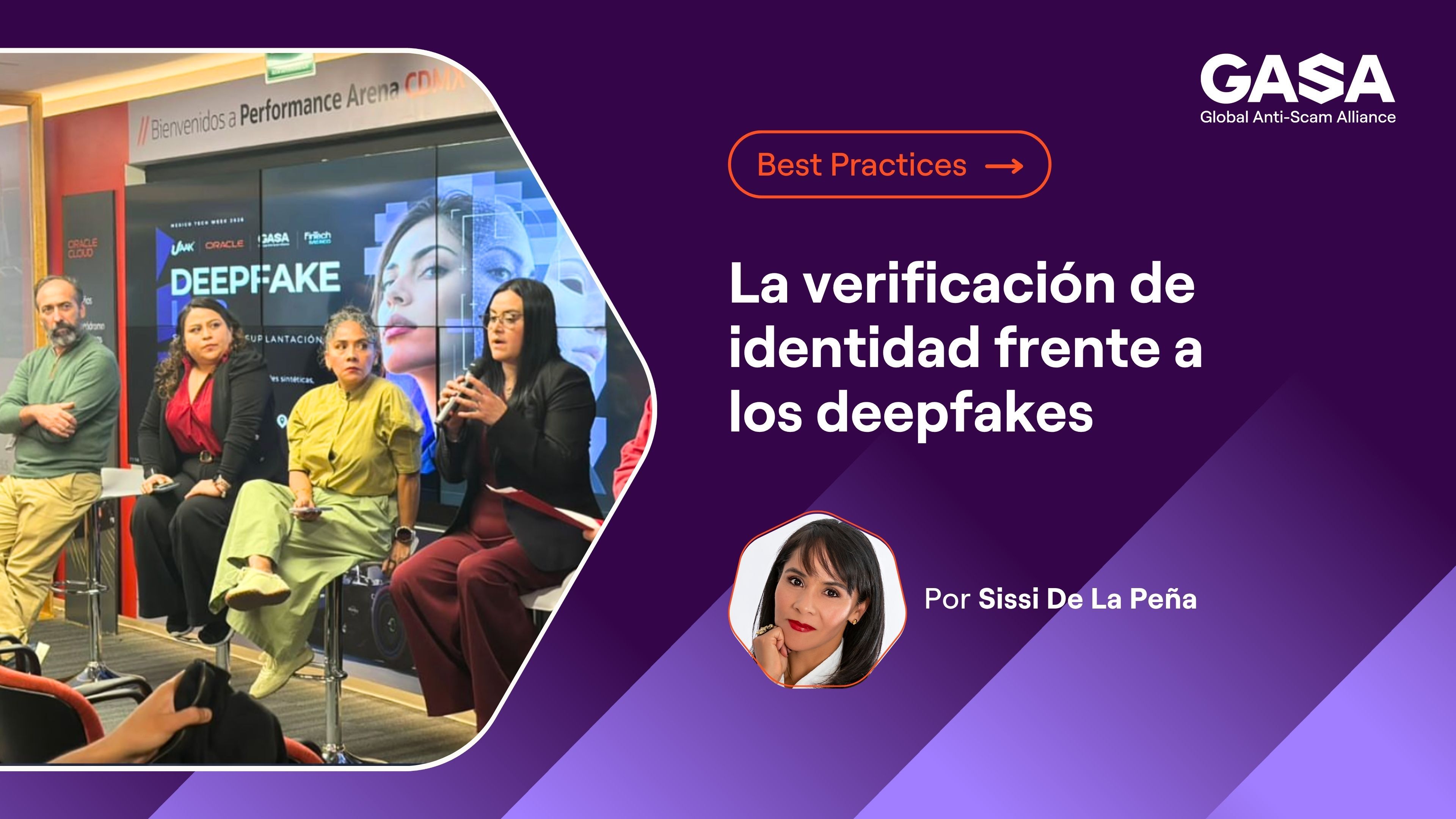
Our colleagues at JAAK emphasized: no system detects 100 percent of deepfakes. Their approach is to view security as an onion, with systems kept up to date through patches, analysis of each transaction, location and document validation, biometrics, and passive liveness checks—all of which provide no clues to the attacker. They highlighted an anecdote in which a team saw firsthand why it’s important to implement so many layers when they created an INE ID card in Messi’s name and managed to get it through a verification process. The result: they had to block video injection in the capture component.
It’s well known that technology clashes with incentives. During this talk, I listened closely to these entrepreneurs’ experiences with identity verification: fraudsters have a higher tolerance for friction and will retry 200 times, while legitimate customers give up after the second attempt. I was also struck by how little seriousness some entrepreneurs attach to security by design, a client who wanted to pay only for approved verifications, and the ethical decision to reject that proposal because it would have forced them to relax their security filters, and noting that the tension between security and growth goals in the fintech sector is sometimes at odds, since opening accounts en masse facilitates money mule accounts.
We also discussed the lack of institutional coordination. Prosecutors’ offices, cyber police, regulators, and companies each handle the same data separately, while money is dispersed in seconds. It’s important to remember that self-regulation should not be set aside while waiting for government regulations, since the law should be considered the minimum threshold and not the maximum standard. Of course, I emphasized that the Fintech Law’s “sandbox” has been underutilized, despite being a tool designed to balance innovation and security.
First, companies must tailor verification to the risk of each transaction and bring together risk, product, compliance, and security teams around the same table. Silvia Díaz, from Oracle, suggested automating only what is reversible first. An irreversible transfer retains a human control point.
Second, regulators can take advantage of the existing Sandbox and establish comparable identity verification criteria for opening accounts, to block the creation of money mule accounts. Industry associations serve as a bridge to decision-makers, who rarely have time to hear about technical issues related to the cloud and containers.
Third, users need to know where their data is stored and to whom it is entrusted. Moya proposed something akin to herd immunity: that banks and associations promote best practices until we stop thinking that this won’t happen to us.
The technology to curb these scams already exists; what’s needed is the decision to use it before the next loss occurs. Every institution that reviews its verification processes, incentives, and coordination channels today takes a step toward curbing fraud. Digital trust is defended through concrete decisions, and the first one can be made right now.
Sissi De La Peña is the director of the Mexico Chapter of the Global Anti-Scam Alliance (GASA).